
Pelvic floor practice · beginner sequence
Kegel practice basics step by step
How to find the muscles once, complete one repetition, and set a short daily practice you can actually finish. No result is promised here — only a sequence to follow.
Find the muscles, squeeze, release, count, rest, breathe — the five stations of one short session.
A sequence to follow, not a list of benefits
This page covers the mechanics of a single pelvic floor repetition and how to turn it into a short daily practice.
It is written for men who have never done Kegel exercises and want a sequence to follow rather than a description of benefits. Read it once, try one set, then come back when you want to adjust the numbers.
The order below matters. Finding the muscles comes first, the squeeze and the release come next, and counting follows only when a single repetition already feels controlled. Skipping ahead usually means practising the wrong movement with more effort.

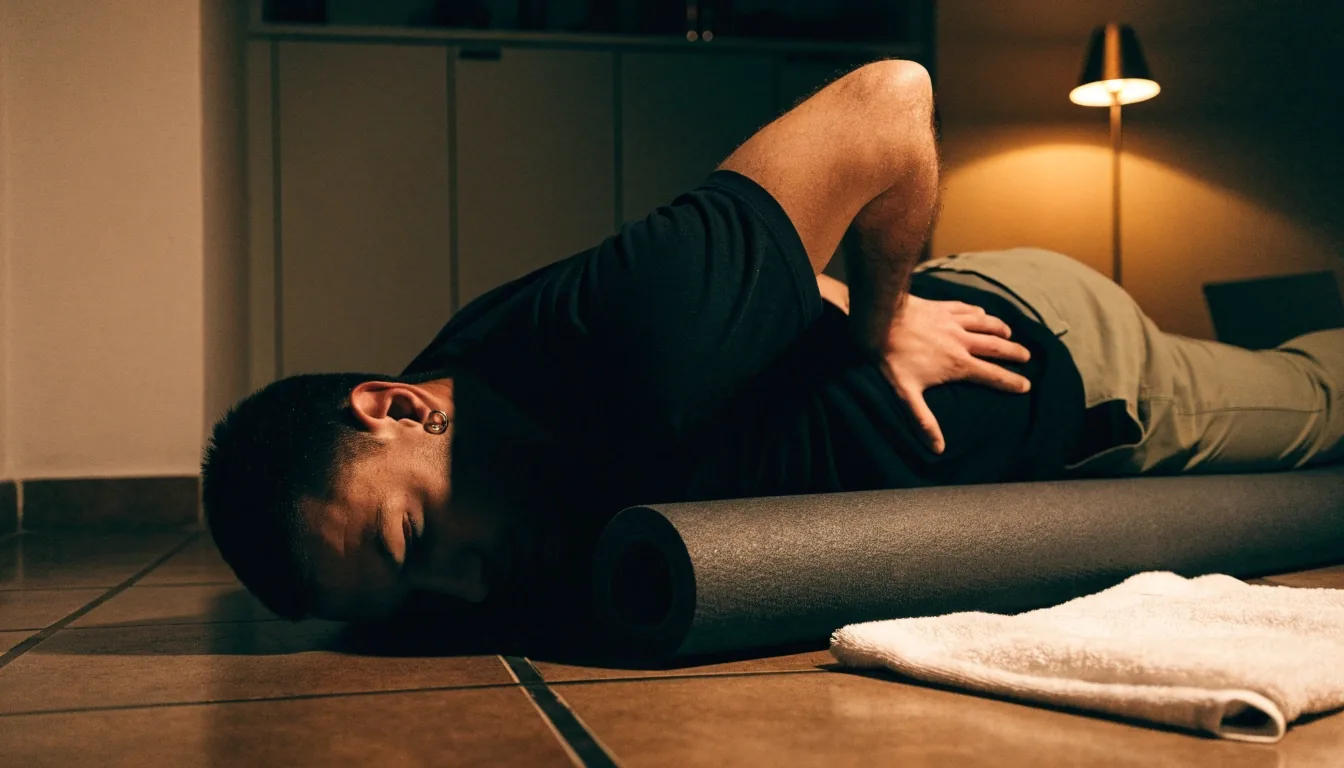
An empty bladder, a quiet room, one lamp — the setup for a first attempt.
5 minFinding the muscles once, then leaving the toilet alone
The standard first step is to try to stop the flow of urine mid-stream or to hold back gas. Both actions use the pelvic floor. This is an identification trick, not an exercise.
Doing repetitions while urinating can interfere with normal bladder emptying, so use the check once, confirm the sensation, and then practise sitting or lying down with an empty bladder. Most men need one or two attempts to recognise the feeling; some need a few days of casual checking before it becomes obvious.
Use it as a check
Confirm the sensation once. Then move to a mat or a chair and leave the bathroom out of the routine entirely.
What a squeeze should feel like
The sensation is a lift inward and upward, as if you are drawing the muscles toward the inside of your body. It is not a hard clench and not a push downward. Verywell Health's men's explainer notes that the testicles may rise slightly during a correct contraction, which is a useful confirmation for some readers. Pressure or bearing down is a sign you are going the wrong direction — stop, breathe out, and start again from rest.
Right direction
A small inward lift you could hold for a few seconds while still breathing normally and keeping the belly, legs and buttocks relaxed.
Try again
A downward push, a squeezed breath, or a tightened stomach. Nothing is lost by stopping the set here and returning to it later in the day.
The squeeze and the release
A repetition has two equal halves. The release is not passive; you are deliberately letting the muscle return to its resting length, and that return is part of the training.
Mayo Clinic's men's guide suggests a three-second squeeze followed by a three-second relax to begin with. Harvard Health's guide uses 3 to 5 seconds for both phases. Pick one number and keep it for the whole set — changing the count mid-set makes it harder to tell whether the last repetition still felt controlled.
Counting repetitions and sets
Once a single repetition is controlled, group them. Mayo Clinic's guide advises building toward 10 to 15 repetitions per set. Verywell Health describes repeat ranges of 10 to 20 repetitions, three to four times per day.
Start at the bottom of the range. If the last repetition in a set feels weaker than the first, the set was too long — end it there and note the number for next time.
Set
8 reps
A comfortable starting length for a first week.
Build toward
10–15 reps
Add only when the whole set stays even.
Per day
1 set
Add a second short set before adding repetitions.
There is no schedule you need to match. The numbers above are reference points from published men's guides, not targets to hit by a certain date.
Hold times and how to lengthen them
Beginner holds sit at 3 to 5 seconds. Verywell Health's explainer describes holds extending to 5 to 20 seconds depending on ability. Add time in small steps, and only when the current hold still feels controlled at the end.
A shaky final second is information: stay at that length for another week or two before adding more. Lengthening a hold too early usually shows up as a shorter, weaker squeeze on the next repetition.
Rest between repetitions and between sets
Rest is the part most beginners cut short. A rough rule is that the rest should last at least as long as the squeeze, and longer if the muscle is tired. Between sets, give yourself a minute or two of normal breathing before starting again.
If you cannot produce a clean contraction after a rest, the session is finished for now. Stopping early is a normal part of the practice, not a sign that something went wrong.

Breathing while you work
Breathe normally through the whole set. Holding your breath raises tension in the abdomen and makes it harder to isolate the pelvic floor. Harvard Health's guide stresses keeping the abdomen, legs, and buttocks relaxed during the contraction, and steady breathing is the easiest way to check that.
If you notice your breath stopping, pause the set and reset. Counting out loud or breathing audibly is a simple way to keep the rhythm honest.
A first session you can actually complete
Five minutes is enough to begin. Lie down, knees bent, one hand on your abdomen to feel for movement. Do five slow repetitions with a three-second squeeze and three-second release, then rest for a minute. Repeat that for two more short rounds if it still feels controlled. That is the whole first session.
-
Step 1
Lie down and settle
Knees bent, feet flat, one hand resting on the abdomen so you can feel whether the belly moves instead.
-
Step 2
Five slow repetitions
Three seconds in, three seconds out, with the breath continuing through both halves.
-
Step 3
Rest for a minute
Let the muscle return fully before starting the next round. No counting during the rest.
-
Step 4
Repeat twice more, or stop
Three short rounds total is the whole session. If the last repetition weakens, finish early.
Where to take it next
When lying down feels reliable, repeat the same set sitting in a chair, then standing. The Practice Positions page compares those three setups. If you want a schedule rather than a single session, the Building a Daily Routine page lays out a weekly structure with progress notes.
Lying, sitting, standing — the same set moves through all three.
Questions that come up first
Short answers to the three things readers ask most often before their first set. If something still feels unclear, the form-cue page walks through the same points with more detail.
Can I do these exercises while urinating?
No. Stopping the flow is useful once, to identify the muscles. Repeating it during urination can interfere with normal bladder emptying. Practise with an empty bladder, lying down or seated.
What if I cannot feel anything happening?
Start lying down with a hand on your abdomen so you can feel whether the belly is tightening instead. If you still cannot isolate the muscles, Harvard Health's men's article notes that a therapist can teach proper technique directly.
How quickly should I add repetitions?
Add them only when the current number feels controlled from the first repetition to the last. Mayo Clinic's guide describes building toward 10 to 15 repetitions per set rather than starting there. There is no schedule you need to match.
Read it once, try one set, then adjust the numbers from what you felt.
This page is informational and describes a practice sequence only. It is not a medical service and makes no claim about outcomes. If something feels painful or unclear, speak with a qualified professional before continuing.
Editorial desk
Jl. Cikini Raya No. 58, Menteng, Jakarta Pusat, DKI Jakarta 10330, Indonesia
Monday to Friday, 9:00 AM – 6:00 PM (WIB)